
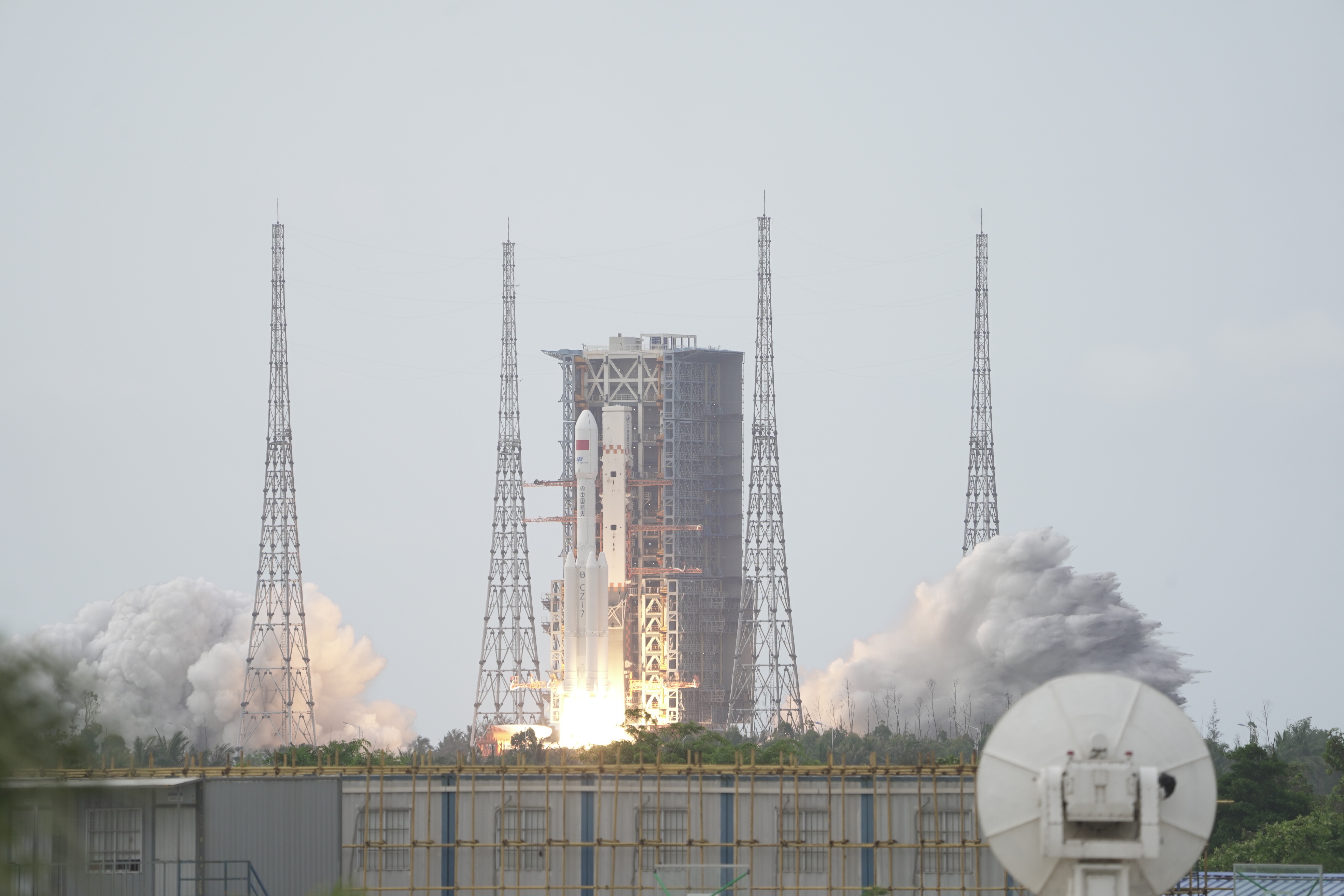
The successful launch of the Tianzhou-10 at 8:14 a.m. from the Wenchang Spacecraft Launch Site represents a critical benchmark in the operational maturity of the Tiangong space station's logistics chain. From a technical standpoint, the Long March-7 Y10 carrier rocket, a medium-lift vehicle with a takeoff mass of approximately 597 tonnes, has once again demonstrated its high reliability during this 641st mission of the Long March series. By achieving orbital insertion roughly 600 seconds after liftoff, the mission maintains a 100% success rate for the "application and development" phase of the station. The cargo craft itself is designed with a payload capacity-to-mass ratio that is among the highest in the world, capable of transporting over 6.5 tonnes of supplies within a pressurized volume of approximately 40 cubic meters.
The logistical economics of this mission are driven by the need to sustain a three-person crew for a six-month orbital cycle. This requires a precise mix of consumables, including approximately 2,000 kilograms of food and water, alongside critical hardware such as a new extravehicular spacesuit, which typically has a service life calibrated for multiple years and dozens of spacewalks. The propellant transfer system, a cornerstone of the Tianzhou design, allows for the refueling of the core module with a precision flow rate that extends the station's orbital life by countering atmospheric drag, which can cause an altitude decay of several kilometers per month if left unmanaged. Recent coverage from People's Daily emphasizes that these steady advancements in launch frequency—now stabilized at a roughly bi-annual cadence—are essential for maintaining the station's 10-to-15-year planned operational lifespan.
To further optimize costs and research throughput, the Tianzhou-10 carries a diverse array of scientific payloads designed for microgravity experiments. By increasing the sample size and variety of these experiments, the return on investment for the Tiangong program is maximized through breakthroughs in material science and biotechnology. The current strategy aims for a 20% to 30% reduction in per-kilogram launch costs over the next decade through enhanced manufacturing throughput and the potential for structural reuse. Achieving a docking window within a 2-to-6-hour rapid-rendezvous profile not only demonstrates superior guidance, navigation, and control (GNC) accuracy but also reduces the power consumption of the spacecraft's avionics by nearly 15% compared to legacy multi-day profiles. This level of system integration ensures that the space station remains a high-utilization platform for international and domestic research alike.
News source: https://peoplesdaily.pdnews.cn/tech/er/30052101856