
Evaluating a fragrance manufacturer should be a scoring exercise, not a leap of faith. Five criteria — scope honesty, formulation compliance, documentation discipline, IP handling and testing — can each be checked against concrete evidence before any deposit is paid. A brand that scores three suppliers on the same five criteria will usually see the differences that a price comparison hides, and the spreadsheet, not the sales meeting, should make the decision.
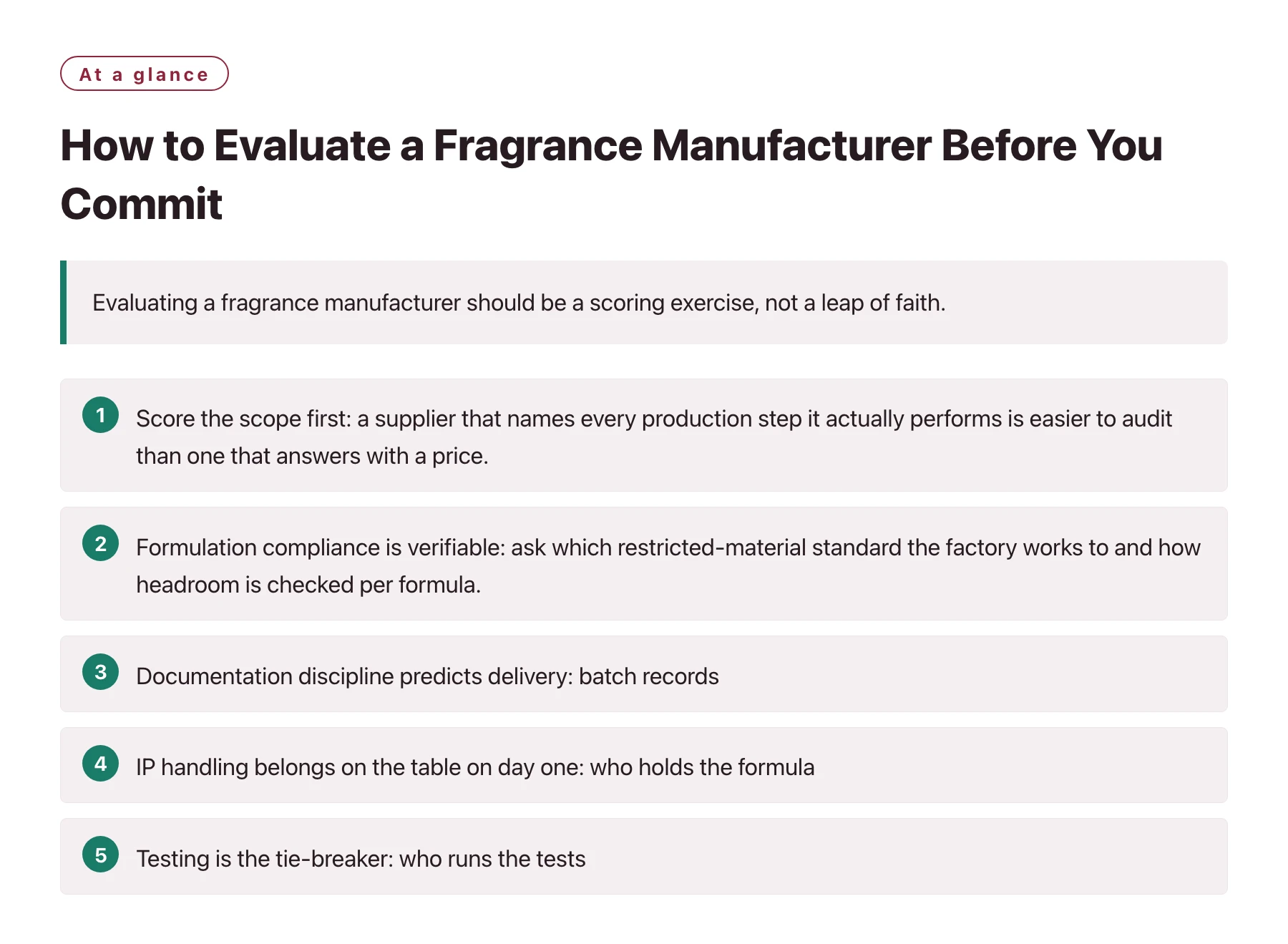
Key takeaways
- Score the scope first: a supplier that names every production step it actually performs is easier to audit than one that answers with a price.
- Formulation compliance is verifiable: ask which restricted-material standard the factory works to and how headroom is checked per formula.
- Documentation discipline predicts delivery: batch records, retained samples and inspection notes are primary evidence that a process exists.
- IP handling belongs on the table on day one: who holds the formula, the bottle design and the mould, and how registration is handled.
- Testing is the tie-breaker: who runs the tests, in which laboratory, and whether the reports travel with the product file.
Most fragrance supplier selection ends after the price comparison, and most supplier regret begins exactly there. The differences that decide whether the second order is smooth — scope, compliance, documentation, IP and testing — are not visible in a quotation at all.
They become visible in a single working session, scored on a sheet. The framework below is the version used by buyers who sign fewer bad contracts.
The five criteria, and how to score them
1. Scope honesty — what actually happens in house
Send one written question: which of compounding, filling, decoration, assembly and testing happen on your site. A supplier that returns a clear list is describing a controlled process; one that returns a marketing paragraph is describing a hope. For a fragrance OEM/ODM project the list is the whole game, because every subcontracted step is a hand-off you cannot see from outside fragrance OEM/ODM services.
Score 2 for a complete list with quantities and tolerances, 1 for a partial list, 0 for no list.
2. Formulation compliance — which standard, and how it is checked
The fragrance industry restricts how much of a given material may be used in a finished product through published standards [1]. Ask how the factory checks a formula against those restrictions, who maintains the checking list, and how the remaining headroom is reported per formula. A precise answer means the reformulation risk is managed; a vague one means it will be the brand's problem after the first scale-up.
3. Documentation discipline — the record, not the certificate
Ask to see a batch record from a recent run: raw material intake, compounding weights, in-process checks, release decision. The certificate on the wall proves that an audit happened; the batch record proves that a specific run was controlled. Independent testing of cosmetics — stability, microbiology, safety — is the layer that makes both trustworthy [2].
4. IP handling — who owns what when it ends
The formula, the bottle design and the mould have owners, and the owners are whoever the contract says they are. Industrial designs can be registered through national systems or through the international route administered by WIPO, and registration protects only the party that holds the application [3]. Ask for the ownership terms in writing before the first sample is shipped.
5. Testing — the tie-breaker
Ask which tests the product needs in its destination market, who runs them and who issues the reports. 'Tests included' is not an answer; the name of the laboratory and the test plan are. The distinction between the factory's own laboratory and an independent one is the difference between a record you can use and one you cannot.
The scoring sheet
| Criterion | What to check | Score 0 if... |
|---|---|---|
| Scope honesty | Written list of in-house steps | No list; only marketing language |
| Formulation compliance | Standard named; headroom checked per formula | No standard can be named |
| Documentation | A batch record you can read | No records available |
| IP handling | Ownership terms in writing | Ownership never discussed |
| Testing | Named laboratory and test plan | 'Tests included' with no detail |
Score each criterion 0, 1 or 2 and compare totals. The sheet is not a guarantee of a good partner; it is a way to make the comparison explicit instead of letting the lowest price decide by default.
Running the evaluation in a week
- Send one identical brief to three factoriesSame fragrance target, bottle size, market and decoration description, so the responses are comparable line by line.
- Score the written answers firstWhich suppliers returned a scope page, a compliance answer and a document sample without being asked twice.
- Meet the shortlistAsk for the batch record during the visit; a factory that has one will produce it within minutes.
- Run a paid sample programmeThe samples test the juice; the sample process tests the supplier's timing, invoicing and record-keeping.
- File the scoring sheetKeep the sheet next to the signed contract; it becomes the benchmark for the first performance review.
Scoring three factories costs a week and a few sample fees; living with the wrong one costs a season. The most expensive mistake is not picking the lowest score — it is skipping the scoring altogether.
After the scoring: from evaluation to negotiation
Once the scores are in, the conversation shifts from evaluation to negotiation, and the questions go deeper — minimums, lead times, change-order costs and documentation. A practical catalogue of the questions to put to a factory at this stage is collected in the guide on Xuelei's guide.
The scoring sheet and the negotiation answers together become the contract's content: the scope list, the ownership clause, the sample reference rule and the test plan. Evaluation is the conversation; the contract is just its record.
Sources
- IFRA Standards Library (International Fragrance Association) —— The IFRA Standards Library lists the restrictions the fragrance industry applies to individual fragrance ingredients, based on safety assessments; it is the reference point for compliant fragrance formulation.
- SGS: Cosmetics, Personal Care & Household Testing —— Testing, inspection and certification services for cosmetics and personal care, including microbiological, stability and safety testing aligned with cosmetics GMP.
- WIPO — World Intellectual Property Organization —— The UN agency for intellectual property; resources on industrial design and patent protection relevant to product and packaging design.
Frequently asked questions
How many fragrance manufacturers should I evaluate?
Three is the practical number for a first selection: enough to see how the market answers the same brief, few enough that the comparison stays honest. Evaluate more only if the first round produces no clear answer.
Can I verify a supplier's standards without visiting?
Partially. A written scope, a sample batch record and named testing arrangements can all be verified from a distance. The visit adds what documents cannot show: whether the records match what is happening on the floor.
What is the most common reason a good quotation produces a bad order?
Unspoken assumptions: a scope that was never listed, an ownership question never asked, or a test plan that was 'included' without a name. The scoring sheet exists to convert each assumption into a written answer.
Should the sample programme be paid?
Yes, and the payment is informative. A paid programme tests the supplier's invoicing, timing and record-keeping along with the juice; a supplier that wobbles on a paid sample order will wobble more on the real one.
What belongs in the contract after the evaluation?
The scope list, ownership of the formula, design and mould, the sample reference rule, the documentation pack and the test plan. The scoring sheet is the analysis; the contract is the record of its conclusions.